A local planning story with a winter question
Kimberley is updating its Active Transportation Network Plan, which covers routes for walking, cycling and rolling. Earlier My East Kootenay Now reporting identified discussions with the city’s Accessibility Advisory Committee as part of engagement. The current municipal project page lists fall 2026 engagement, winter drafting, community review in early 2027 and adoption targeted for spring 2027. Those are planning stages, not evidence that a new plan has already been adopted. The winter operations question is practical: can someone use the connection when snow changes the route?
What Kimberley’s committee actually does
The city describes its Accessibility Advisory Committee as an advisory body that helps Council and staff consider barriers in civic infrastructure, services and online resources. Its work includes advice on the accessibility plan, priorities and public feedback. Residents can send questions or comments to the Corporate Administration Office at 250-432-1334 or assistant@kimberley.ca. The committee provides advice; it is not a snow-clearing dispatch service. Use the responsible municipality’s service-reporting channel for an immediate maintenance problem.
Small communities can work together
The East Kootenay Accessibility Advisory Committee was formed in 2023. RDEK identifies Cranbrook, Canal Flats and Invermere as its participating municipal partners. The regional district says its Accessibility Plan was adopted on February 13, 2026. That gives residents of a city, a village and a district municipality a concrete example of a shared regional arrangement. Kimberley has its own committee; it is not listed among those RDEK partners.
Do all cities have to have a committee?
For British Columbia, municipalities and regional districts are prescribed organizations under section 3 of the Accessible British Columbia Regulation. Part 3 of the Act requires an accessibility committee, a plan and a public feedback process. Plans must be reviewed and updated at least every three years, with committee consultation. A shared arrangement does not mean every town needs a separate standalone committee. These BC rules do not establish a universal requirement for every city elsewhere, and this article is not a compliance audit of every BC municipality.
Vancouver has one too
Vancouver’s official Accessibility Strategy page identifies an Accessibility Committee that advises on removing or preventing barriers and guides the strategy. It also links the related Persons with Disabilities Advisory Committee. Large-city and small-community arrangements can differ while serving the same basic purpose: bringing access barriers into public decisions.
Make the winter barrier specific
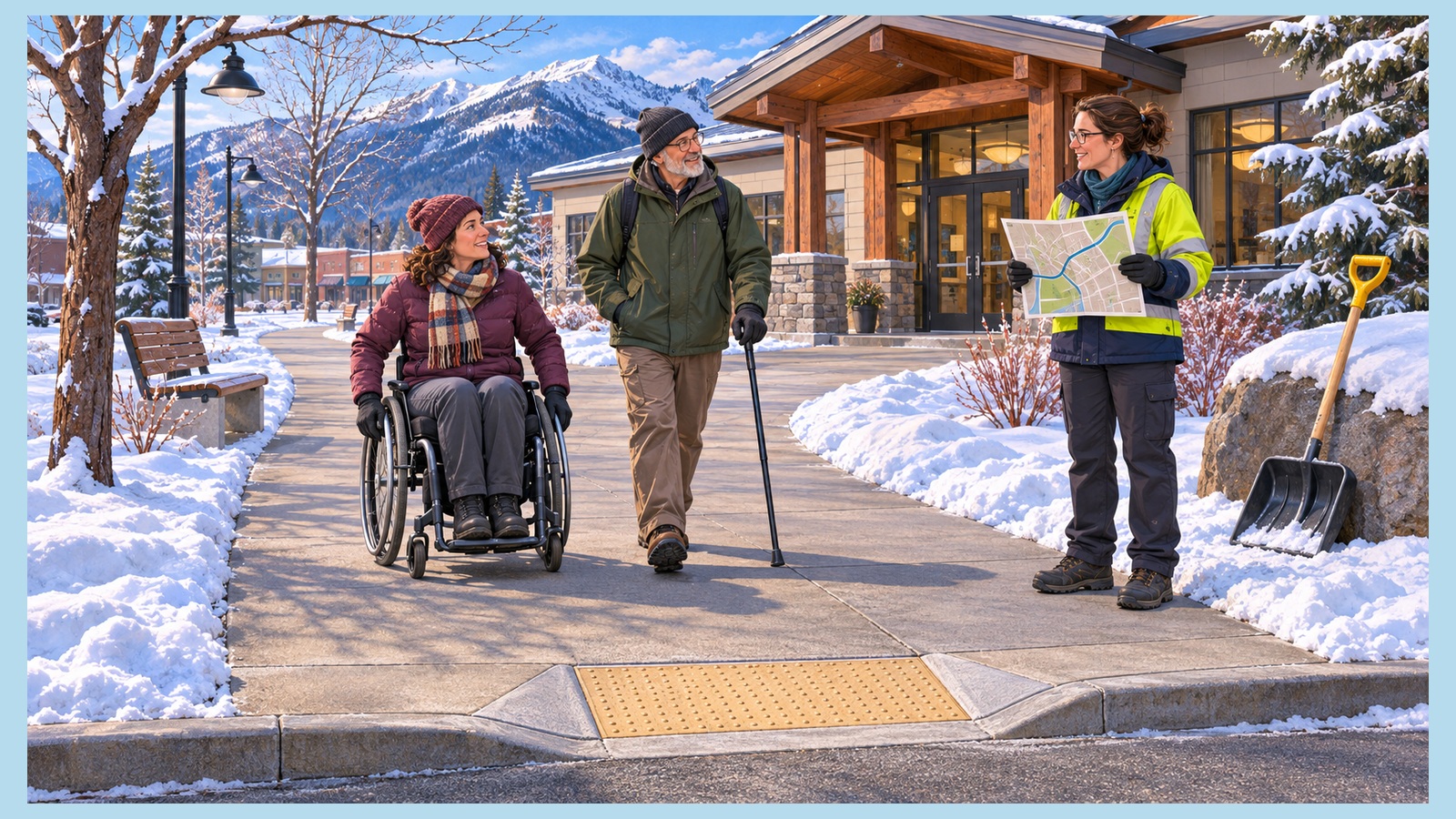
For readers raising a winter access issue, Plow.news suggests describing the whole connection: where the journey starts, where it stops and what blocks it. A snow ridge across a curb ramp, an inaccessible temporary detour or a cleared path ending before the entrance tells staff more than a general request for better accessibility. Include the location and date, and provide a photograph only if safe and appropriate. Avoid publishing another person’s disability or personal information. This is reporting guidance, not a finding that any named municipality has those conditions.
Check the right door before sending a report
For Kimberley’s transportation-plan work, use the official Engage Kimberley project page to check the latest participation options and timeline. Its September 10 in-person event is a past event, not a new invitation. For committee questions, use the city’s committee contact. For the RDEK plan and participating communities, begin with the regional accessibility page. Ask who owns the affected walkway where municipal and private-property responsibilities meet. A committee can inform plans and priorities; a dated maintenance report also needs to reach whoever can act on that particular location.
What this means for winter operations
A plan becomes useful to a snow operation when it identifies the pedestrian links that must remain connected and gives people a way to report a gap. Our editorial takeaway is to put those links into route planning, snow-storage decisions and follow-up checks, with input from the people who use them. A private strata has a different legal position from a municipality; the linked PlowWow™ guide explains that distinction and offers a property-management checklist.
RDEK: adopted Accessibility Plan and regional committee partners ↗
City of Kimberley: Active Transportation Network Plan update ↗
City of Kimberley: Accessibility Advisory Committee role and contact ↗
Accessible British Columbia Act, sections 8–12 ↗
Accessible British Columbia Regulation, section 3 ↗
City of Vancouver: Accessibility Strategy and committee ↗
My East Kootenay Now: earlier reporting on Kimberley’s transportation-plan engagement ↗
Source reviewed Nov 13, 2026. Current official pages checked November 13, 2026. This is a service explainer, not an announcement of a new committee appointment, open recruitment or a newly adopted Kimberley transportation plan. Dates and roles are attributed to municipal and legislative sources. No source photographs reused.
Related resources
PlowWow™: BC strata winter accessibility and whole-route planning →