A forecast covers a region. Service happens at a property.
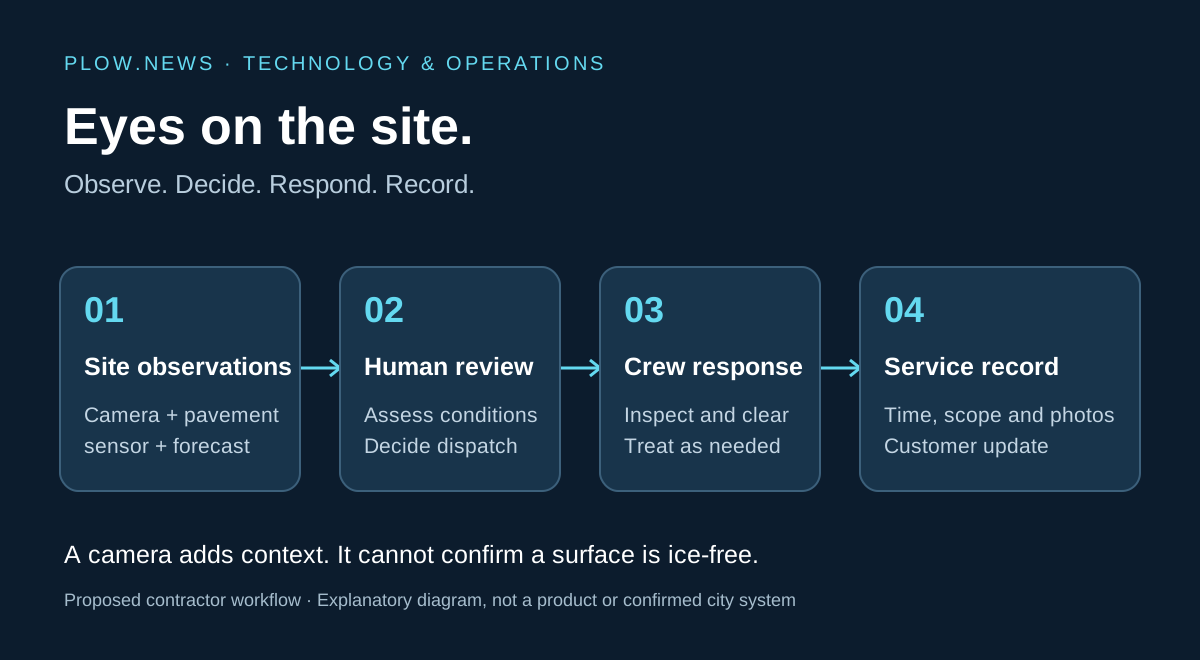
A forecast tells a snow contractor what might happen across a region. A camera at a customer’s property can help show what is happening there. Put that view alongside pavement readings, vehicle tracking and service records, and winter maintenance can become a more informed operation: observe the conditions, decide what needs attention, send the crew and document the work. That is the opportunity for contractors serving anything from a single storefront to a portfolio of strata properties.
What Montréal has announced
CBC reports that Montréal announced $15.8 million to modernize winter road maintenance, including $13.3 million for 43 new snow-removal machines. The reporting also describes a planned weather and operations monitoring centre and the gradual rollout of Go-Géo for public tracking of sidewalk salting and clearing. AI-assisted equipment tracking and crew coordination are being explored. These are announced plans and developing capabilities, not evidence that every feature is operational or has delivered measured improvements.
Another set of eyes between visits
A weather-resistant camera overlooking an entrance, driveway or parking area could help a dispatcher review accumulation, access and visible conditions between inspections. A cellular trail camera aimed at a fixed snow-depth reference and a priority route is one possible pilot. Scheduled photographs could provide a consistent view as a storm develops. Images might reveal fresh accumulation, vehicles blocking access or a windrow across an entrance. This is our proposed contractor application, not a camera programme confirmed in the Montréal announcement.
Seeing pavement is different from measuring it
Images provide context, but they cannot reliably establish traction or distinguish every patch of black ice from wet pavement. Purpose-built pavement sensors can add surface temperature and moisture or surface-state observations. Vaisala’s DRS511 is one example of that technology, rather than a product we have independently tested. Site observations, forecasts and sensor readings should inform an assessment together. A single image or reading should not be presented as proof that an entire property is safe.
A Metro Vancouver application
For Metro Vancouver contractors, a useful application would be watching conditions after rain, melting snow or a daytime thaw as temperatures fall. A shaded walkway or exposed ramp may behave differently from another part of the site. The aim would be to identify where an inspection may be needed, then make a treatment decision from current conditions and the agreed service scope. Monitoring should not automatically trigger chemical application simply because the air temperature crosses a generic threshold.
Close the loop after dispatch
A property history should connect the observation to the response: what prompted review, when a crew arrived, which areas were cleared, any access restrictions, and what de-icing material and quantity were applied. Completion photographs and follow-up observations add context. GPS can help establish where a truck travelled; it does not by itself establish which surfaces were treated. A short customer update can then explain completed work and the next planned check. These records document observations and service, rather than guaranteeing a hazard-free surface.
Someone still has to make the call
Montréal’s announcement also prompted questions about who will control operational decisions. Contractors need equally clear responsibilities. Who reviews alerts, who authorizes dispatch, and who follows up after treatment? An old image must show its capture time. Failed connectivity must not look like unchanged conditions. Camera placement, battery performance, night visibility and lens obstruction all need checking. Property-owner permission and controlled access to recordings should be part of setup, with views focused on the service area.
Start with a measured pilot
A sensible trial would cover a few properties with different layouts and exposure. Keep ordinary inspections in place while comparing remote observations with what crews find on arrival. Measure inspection travel, time from observation to review, response time, unnecessary or missed alerts, equipment reliability and customer communication. Compare results across similar conditions before expanding. Potential savings and faster responses are hypotheses to test, not established outcomes. Better information earns its place when it helps the contractor make and record better decisions.
CBC: Montréal announces $15.8M to modernize winter road maintenance ↗
Vaisala: pavement temperature and surface-state sensing ↗
Source reviewed Oct 21, 2026. CBC reporting was reviewed from the article text supplied to the editorial desk. Montréal’s announced plans are distinguished from our proposed contractor workflow. No camera deployment, AI accuracy, cost saving or PlowWow monitoring capability is claimed as verified. Plow.news and PlowWow share IAM network ownership.