How long until Chinese snow equipment wins more Canadian work?
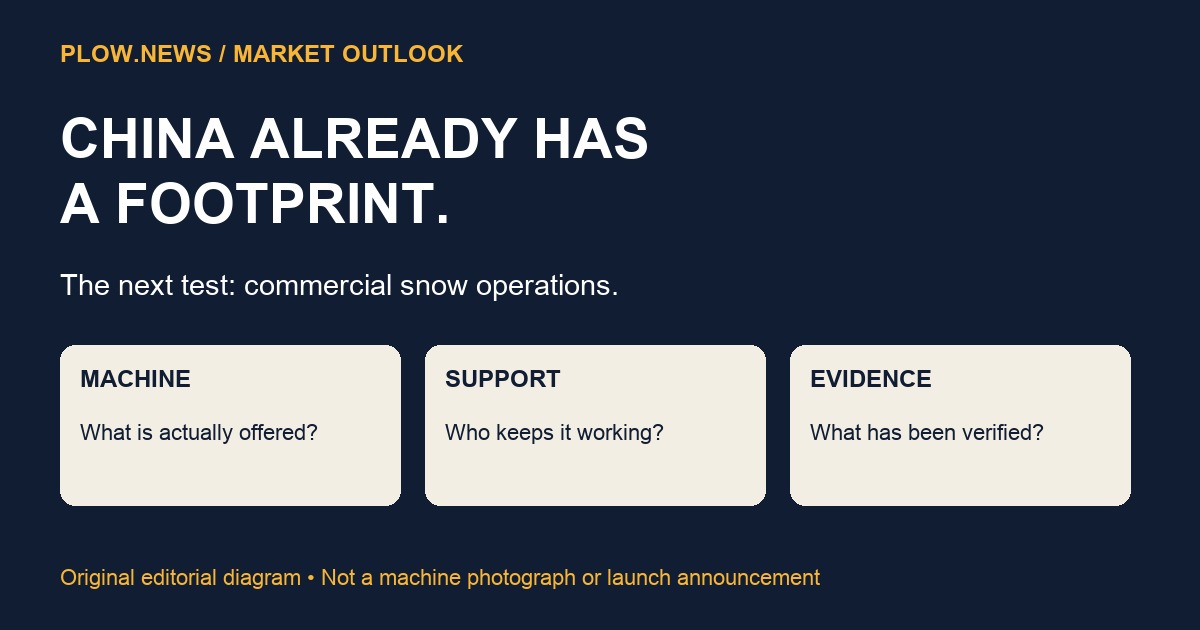
The useful answer starts with a correction: Chinese-origin snow equipment is already part of Canadian supply. The question is how much more commercial responsibility buyers will entrust to it. That depends on the product and support behind it, not a single arrival date. Our outlook is a set of conditions to watch, not a numerical sales forecast or a recommendation to purchase.
The trade baseline is real—and broader than a truck plow
World Bank WITS, presenting UN Comtrade data, records Canada importing US$61.685 million from China in HS 843020 during 2024, against US$171.512 million from all origins. Dividing those values gives about 36% of imports in that category. The classification covers non-self-propelled snowploughs and snowblowers. It is not a measure of Chinese-brand commercial truck-plow sales, installed fleet share, Canadian retail revenue or this winter’s market. Different-sized products are mixed together. Do not turn its unit count into a claim about professional fleets.
Why the Tianjin machinery story matters
The Macau Post Daily carries a Xinhua analysis about China’s farm-machinery industry moving into higher-value products and overseas markets. Its page is dated October 29 in Macau; this Canadian analysis is dated October 28. It is agricultural reporting, not evidence that a snowplow has been launched in Canada. Separately, Zoomlion’s October 27 company announcement describes a 9DX hybrid tractor with a claimed peak output of 1,600 horsepower. That is a manufacturer claim about agricultural equipment, not an independent snow-duty test. The wider signal is manufacturing ambition; the winter-market inference is ours.

The next foothold may be smaller than the biggest headline
Our near-term scenario is selective adoption: a buyer tries a particular attachment or machine on work where its support and backup arrangements can be tested. A lower purchase quote can start the conversation. It cannot establish performance, fit or reliability. A credible Canadian seller should be able to identify the actual model, compatible carrier, documentation, warranty administrator and local service route. “Ships to Canada” answers a logistics question; it does not answer who helps when the machine stops during a storm.
A commercial route buys uptime
Before allocating contracted work, ask where common wear parts and critical service items are stocked, how orders are handled outside ordinary hours, and who can diagnose the actual system. Obtain written answers rather than assuming a familiar-looking connector or attachment plate guarantees compatibility. Ask for a demonstration relevant to your site and conditions, with the correct operating instructions. A route with narrow access, parked vehicles or limited snow storage is a different assignment from an open demonstration yard. These are buyer checks, not a claim that equipment from any one country passes or fails them.
Compare the complete ownership problem
Put delivered equipment, fitting, required accessories, commissioning, training and service arrangements beside the purchase quote. Confirm applicable import treatment with the responsible supplier or qualified adviser instead of assuming a universal tariff. Then consider backup capacity and likely resale channels. We are not assigning a dollar saving: freight, exchange rates, configurations and support terms vary. A cheaper machine with a workable parts plan can be competitive; a low invoice without a workable recovery plan can be an expensive way to miss a service obligation.

What would accelerate adoption—and what would slow it?
Our stronger-adoption scenario requires repeatable local demonstrations, clearly supported products and buyers who can obtain parts and qualified help. It becomes more persuasive when existing users can describe several winters of comparable work, rather than a short promotional clip. Our slower scenario is fragmented availability: attractive prices but uncertain fit, inconsistent documentation, unclear warranty responsibility or long recovery times. Established suppliers also compete on these same factors. There is no defensible evidence here for a year when one origin “takes over,” or a percentage it will hold in 2030.
What Plow.news will watch next
Watch the Canadian distribution and service evidence, not just the horsepower announcement: named support locations, published warranty scope, actual product availability and documented cold-weather operation. Keep Chinese manufacture, Chinese ownership and the branding on the hood separate. A multinational product made in China is not automatically a new Chinese brand. Our companion Kong analysis examines that distinction through John Deere’s manufacturing footprint. Until model-specific evidence arrives, the practical conclusion is simple: there is already an import footprint, but winning dependable commercial routes requires a support system that works where the customer works.
WITS / UN Comtrade: Canada 2024 imports, HS 843020 ↗
Macau Post Daily / Xinhua: farm machinery analysis (Macau date October 29) ↗
Zoomlion: October 27 CIAME manufacturer announcement (Chinese) ↗
John Deere worldwide locations ↗
Source reviewed Oct 28, 2026. Trade values are US dollars and import-category data, not brand sales or current fleet share. Product statements are attributed; forecasts are explicitly editorial scenarios. No new Canadian product launch is asserted.
Related resources
Kong: Chinese-built machinery and the Canadian support test →