The news is uncertainty, not a booked snow event
CTV News reported on October 28 that meteorologists are watching a possible early weakening of the polar vortex, with the outcome for Canada unresolved. That is a reason to review winter readiness, not a prediction of a particular storm. Our operational takeaway is to make the business ready while keeping dispatch decisions tied to local forecasts and site conditions. Do not sell an unverified cold spell as guaranteed work.
The supplied November split analysis remains conditional
Severe Weather Europe’s October 28 analysis discusses model projections of an unusually early polar-vortex disruption in November. A forecast split or wind reversal is not an observed record and does not establish snowfall at a Lower Mainland address. NOAA’s October ENSO discussion also describes a strengthening El Niño. Treat both as large-scale context; use current local forecasts and site conditions for an operating decision. Our reading: separate a model scenario from a verified event, and both from a local operating decision. A high-altitude wind-reversal threshold does not price a contract or determine how much material a walkway needs.

Three different questions need three different answers
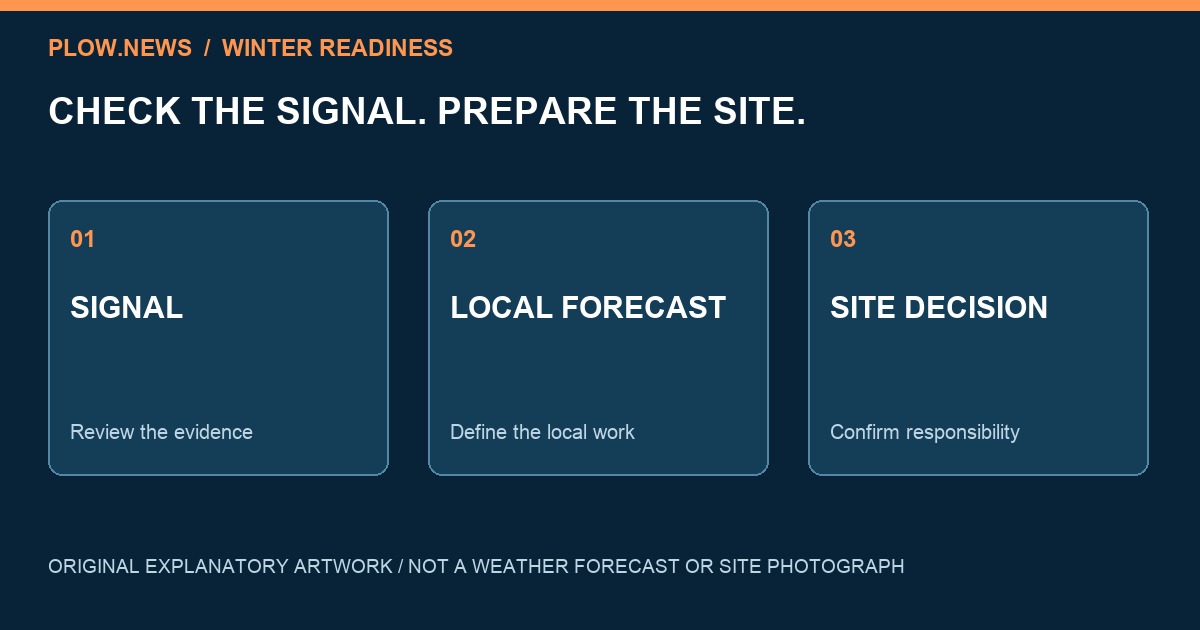
NOAA’s National Weather Service explains that the polar vortex is an atmospheric circulation, rather than a storm sitting over a property. ECCC’s seasonal guidance describes probabilities across longer periods. Neither source supplies a truck-route start time. A contractor needs to distinguish the broad signal, the approaching local hazard and the actual condition at the site.
Use the headline to close preparation gaps
Review the equipment roster, named operators and backup arrangements. Check which sites need hand crews, which need machines and who can authorise extra work. Confirm access instructions, snow-storage areas and the contact available outside office hours. These are preparation questions the company can resolve without pretending to know December’s weather.
Put decision points in writing
A useful plan records the agreed service trigger, the person monitoring conditions, the person making the call and the limits of the contracted work. If additional visits, material or hauling may require approval, settle the process before an event. No single trigger suits every contract. The question is whether the client and contractor understand the same one.
Separate capacity from an unconditional promise
A possible colder episode does not establish how many sites a crew can cover. Review travel time and overlapping obligations before accepting another route. Ask how a machine failure, blocked entrance or late change will be communicated. This is editorial planning guidance, not a forecast of contractor revenue, local snowfall or service demand.
What would justify changing the plan?
Use current ECCC forecasts and warnings for the relevant location, then reassess as timing, precipitation type and temperature become clearer. Record when the forecast was checked. A warming or weakening high in the atmosphere can inform the weather discussion; it cannot substitute for a current, local operating decision.
For Lower Mainland owners
Vancouver, Burnaby, Surrey, Langley and Richmond properties need their own access and responsibility records. Check municipal guidance separately from a private service agreement. For a service enquiry, describe the property and confirm availability with PlowWow™; a weather story does not reserve a crew. Snow Intelligence remains first-year beta, and this article does not announce a forecasting, dispatch or automatic billing feature.
CTV News — Devika Desai, October 28, 2026 ↗
NOAA/NWS — polar-vortex background ↗
Environment and Climate Change Canada — seasonal forecast guide ↗
Severe Weather Europe — original October 28 model analysis ↗
NOAA CPC — October 8 ENSO discussion ↗
Source reviewed Oct 28, 2026. Forecast uncertainty preserved. This is operational planning analysis, not a local snowfall forecast or independent equipment test.