A higher rate is an attempt to buy capacity
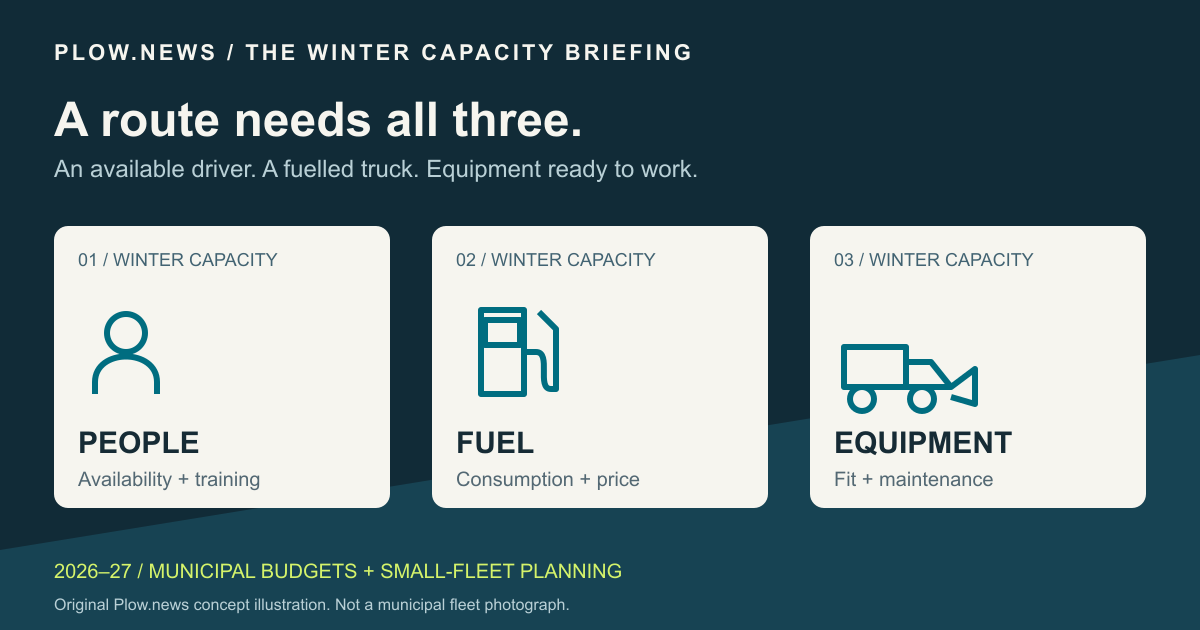
A winter route needs both a serviceable machine and an available operator. New Hampshire’s new-season rate decision is a useful case study in what happens when that combination becomes harder to secure. Ethan DeWitt’s NH Bulletin reporting, republished by Business NH Magazine on October 26, says the Executive Council approved a 15% increase for contracted winter crews the preceding week. This is a New Hampshire decision, not a new Canadian rate or a guarantee that every snow contractor will receive a similar increase.
Read the operator line separately from the truck rate
NHDOT’s October 1 document for the October 21 meeting puts the CDL operator component at $30.42 per hour, up from $26.45, within an overall rental-rate increase. Appendix B separately prices equipment with an operator. The department estimates approximately $2 million–$3 million in additional annual costs and warns that an average or heavier winter could require more funding. These are the department’s projections; the eventual bill depends on the season. All dollar amounts in this article are US dollars.
Other towns are competing for winter availability
Halifax, Massachusetts, advertised on October 19 for experienced 2026–27 plow contractors and offered a conditional $400 end-of-season bonus per equipment unit for applications submitted by November 6. Andover’s October 8 notice offers $300 per vehicle and a conditional 10% attendance bonus, with paperwork due November 9. Concord, New Hampshire, advertises seasonal operator work at $21.69–$22.85 an hour, guaranteed 40-hour weeks and a $1,000 completion-linked sign-on package. Read each notice’s eligibility and payment terms. Recruitment offers show active competition; they do not, on their own, establish how many positions remain vacant.
A municipality needs a rate-and-hours budget
For a budget planner, an hourly increase is only half the calculation. A useful forecast separates the price of a unit of service from the number of units likely to be required. Build light-, typical- and demanding-season scenarios using the municipality’s own operating history. Include return treatments, hauling, loading, repairs and standby arrangements where those costs actually apply. A flat contingency expressed as a percentage can hide which assumption is driving the exposure. Show elected officials the operational trade-off: what capacity the base budget buys, what calls for a contingency release and who authorises it.
Fuel creates a second moving cost
There is no single current fuel price that represents every depot, supplier or fleet. Use the actual invoiced price and the equipment’s measured consumption. As an illustrative sensitivity test, five trucks each burning 4 US gallons an hour for 300 operating hours would consume 6,000 gallons. A $0.75-per-gallon change would alter fuel cost by $4,500, assuming those hours and consumption stay unchanged. This is arithmetic, not a reported fleet, a pump-price claim or a prediction. Convert units before applying a US-gallon example to Canadian records; do not substitute litres directly.
Do not count the same cost twice
A contractor invoice can already include the driver, fuel, maintenance and equipment. Before adding a fuel allowance or wage adjustment to a forecast, inspect the agreed rate basis. Ask whether fuel is included, whether an adjustment clause exists, what reference price it uses and when it changes. Separate a contractor’s gross hourly receipts from the driver’s earnings and from the owner’s margin. A larger invoice is not automatically a larger profit. The useful comparison is the complete scope and cost allocation, including who carries breakdown, readiness and weather-volume risk.
For a small fleet, availability has to be real
An owner with a handful of trucks cannot solve a driver gap simply by promising a higher hourly amount. Compare the complete offer: predictable payment, paid familiarisation, maintained equipment, realistic mobilisation requirements and an agreed backup plan. Discuss winter availability before accepting additional sites, and confirm whether a driver has conflicting commitments. A route that looks attractive on paper can become fragile if its only trained operator is unavailable. These are practical planning questions, not findings that any named business has lost staff or failed to meet a contract.
Sell the capacity you can support
List each machine, its trained operator, its backup arrangement and the route hours it can credibly cover under the conditions being priced. Keep travel, loading and maintenance time visible. Then test a difficult event with a breakdown or an absence. If the plan only works with every truck continuously productive, the spare capacity is fictional. Reducing an overextended route, arranging genuinely available subcontract capacity or changing a quoted response window may be more credible than selling another promise. Confirm all changes with the customer through the actual agreement.
A better conversation with property customers
Explain what the seasonal price reserves and what event-based charges cover. Identify the included areas, trigger, material assumptions and any separately quoted return work. If a fuel or extraordinary-work clause is proposed, make its calculation and approval process understandable before the season. Avoid turning a news headline about another jurisdiction into a blanket justification for a local surcharge. Customers can assess a documented site scope and a clear cost basis; they cannot assess a generic claim that everything is up. Any local quote still needs its own measurements and review.
The question before the next storm
Ask: if the expected driver is unavailable and fuel costs differ from the estimate, which part of this route plan still works? Municipalities can put that question into procurement and contingency planning. Smaller fleets can put it into hiring, equipment readiness and customer scope. The common objective is dependable capacity with honest limits. A pay announcement is a starting point for that work, not evidence that the staffing problem is solved.
NHDOT: October 1 rate proposal, presented as October 21 Council Item 33 — pages 1–2 and Appendix B ↗
Archived copy of the NHDOT primary document — all five pages ↗
Ethan DeWitt / NH Bulletin, via Business NH Magazine: October 26 report on approval ↗
Town of Halifax: October 19, 2026 contractor recruitment notice ↗
Town of Andover: October 8, 2026 contractor recruitment and attendance bonuses ↗
City of Concord posting through NH Municipal Association: October 16 seasonal operators ↗
Source reviewed Oct 26, 2026. Primary NHDOT document reviewed through the linked archived copy where the official host was unavailable. The approval is attributed to Ethan DeWitt’s NH Bulletin report republished by Business NH Magazine on October 26. Municipal offers are individual recruitment notices, not a national vacancy survey. All amounts are US dollars. Fuel examples and fleet recommendations are our analysis, not quotations, current pump prices or a forecast. Plow.news and PlowWow™ share IAM network ownership.
Related resources
Related: Quebec snow renewals, fuel pressure and contract scope →
Related: seasonal versus per-event snow-service pricing →
Discuss a Lower Mainland property plan with PlowWow™ — availability requires confirmation →