Imagine getting the message before the truck turns onto your street.
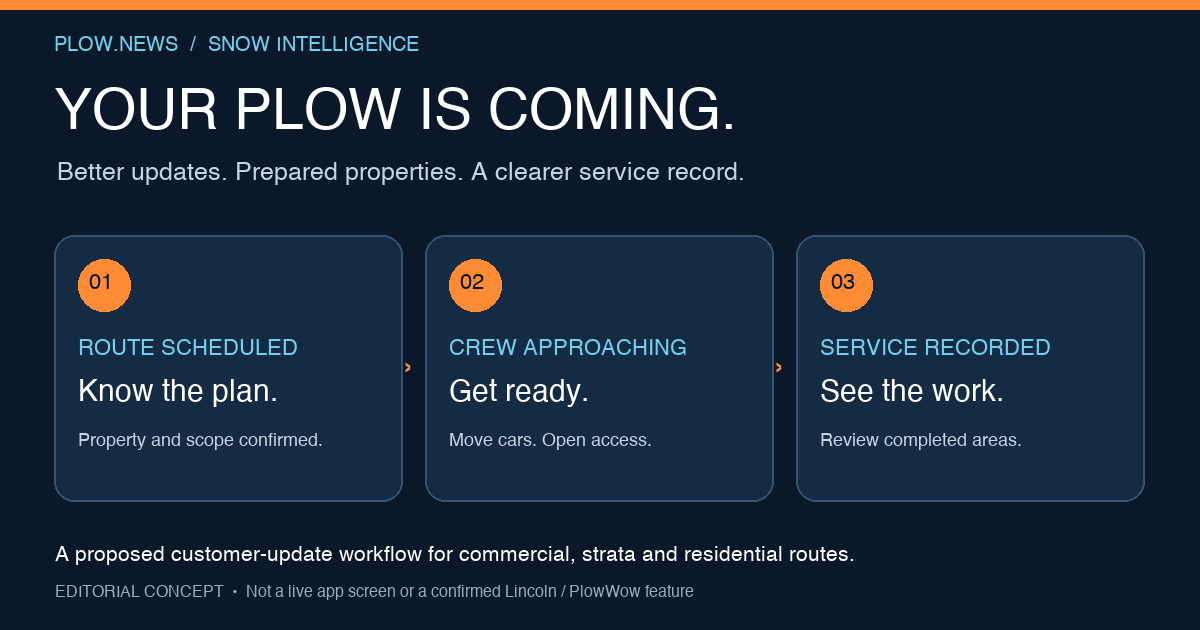
Your phone lights up: the snow crew is approaching. There is time to move the car, open the gate or let the caretaker know. For a business, the same message could reach the opening manager before deliveries arrive. For a strata property, it could give residents a useful reason to clear the visitor spaces. That is the promise of snow intelligence: taking information collected during winter operations and turning it into something a customer can act on. The useful question is not simply where a truck appears on a map. It is what the customer needs to know next, how reliable that information is and whether the contractor can keep it current.
What Lincoln’s announcement actually says
KLIN reports that Lincoln is adding condition-responsive de-icing technology to six snowplows and plans eight additional equipment operators. It also describes existing GPS tracking for city and contractor plows, plus a new text service for storm information, parking bans and other disruptions. These are related tools with different jobs. The report does not announce an address-specific “your plow is coming” notification. That is the next-step opportunity explored here: connecting an assigned route, a changing arrival estimate and a clear customer message. Lincoln’s announcement is the starting point for this analysis, not evidence that the proposed customer workflow already exists.
From a moving dot to a useful service update
A location marker answers one question: where is the vehicle reporting from? A customer usually has several more. Is that truck assigned to my property? Is it travelling here or heading somewhere else? Is the driver clearing the parking lot, treating the walkway or returning for another pass? A useful system connects the vehicle to a defined job and an understandable status. Route scheduled, crew approaching, work in progress and service recorded are more meaningful than an unexplained dot. Each status should include a recent update time. When information stops arriving, the screen should say so rather than continue to look current.
What this could look like for a commercial customer
Consider a retail plaza preparing to open during an overnight snowfall. The property manager needs access to the customer entrance, the delivery route and accessible parking. An approaching-crew alert could prompt the manager to contact tenants, ask for vehicles to be moved from agreed areas and make sure a locked service gate is available. The message should identify the property and the relevant work, with a broad arrival window rather than a minute-by-minute promise. If a loading bay is blocked, the crew could flag the restriction and the manager could respond through an approved contact channel. This is coordination around a real job, not a generic storm warning sent to everyone.
Opening hours change the conversation
A café opening at dawn, a clinic expecting patients and a warehouse receiving an early delivery can have different priorities even within the same neighbourhood. Snow intelligence should show the contractor those requirements before dispatch, then explain the current service plan to the customer. A business might need the front entrance assessed before staff arrive while the larger lot follows under the agreed route. That sequence belongs in the scope and customer update. An arrival estimate alone cannot tell the manager that a particular entrance is ready. The useful message separates planned arrival from completed work and makes any uncompleted priority area visible.
For residential clients, keep it wonderfully simple
A homeowner should not need to study a fleet dashboard to understand a driveway visit. A short notification could say that the assigned crew is approaching and remind them to move a parked vehicle if they can do so safely. A second update could confirm which work was recorded and whether access was restricted. There should also be an easy way to report a problem without starting a new conversation from scratch. The customer can decide how much detail to view. Most people will want a clear status first, an approximate window when available and a human contact when the plan changes. Extra charts belong behind that simple first screen.
Strata properties need one coordinated version of the plan
Condo and townhouse sites introduce shared entrances, visitor parking, fire access, ramps and pedestrian routes. A message to every resident can create confusion if it does not match the instructions given to the property manager. A better arrangement would define who receives operational updates and who distributes resident notices. The caretaker might receive approaching-crew information while residents receive a practical parking instruction through their normal channel. Completion records should distinguish the areas actually serviced from areas still blocked or outside the contract. A shared status can reduce conflicting explanations, but only when the building’s contact list, permissions and service scope are maintained.
Give an arrival window, then update it honestly
Winter routes change. Traffic, heavier accumulation, blocked access, equipment trouble and repeat treatment can all affect the next visit. A useful notification should describe an estimate as an estimate and show when it was last revised. If the expected window shifts materially, send a clear update rather than leaving the customer watching an old time. Where the contractor cannot produce a credible estimate, an honest route-status message is better than artificial precision. A small pilot can establish which milestones are reliable enough to share. The goal is confidence in the information, not a countdown that appears accurate until the first difficult storm.
Municipal streets and private properties are different jobs
A city plow passing down the street does not establish that a private driveway, shopping-centre lot or strata walkway has been cleared. Likewise, a private contractor’s route update does not tell a resident that the city has treated the road outside. An intelligence screen should identify the organisation responsible for each operation and avoid blending unrelated progress indicators. It could provide a link to an official municipal tracker alongside the customer’s private-service status, clearly labelled as separate information. The same distinction matters after a street plow creates a windrow across an entrance. Whether a contractor returns to address that windrow depends on the agreed service scope and current route conditions.
Arrival, completion and surface condition need separate labels
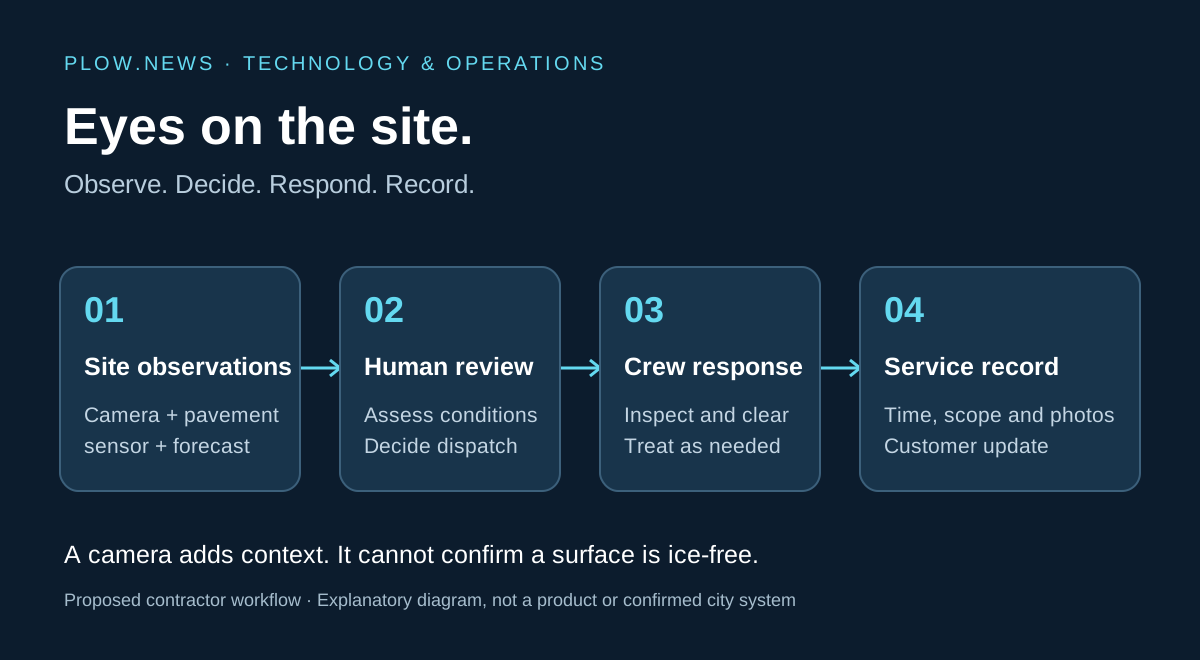
A truck arriving is an event. Clearing a defined area is a task. The condition of that surface after the work is another observation. Good records should preserve those distinctions. GPS can help document a vehicle’s reported location, while time-stamped crew notes and photographs add context about the work. Treatment records can describe the material and quantity applied where those details are captured. None of these items alone proves that every part of a property is free of ice or that conditions will stay unchanged. A completion message should explain the recorded service and any limits, with a route for follow-up if the customer sees a concern.
Contractors benefit when the message matches the dispatch board
For the snow-removal company, the attraction is a more consistent exchange with customers while crews concentrate on the work. Instead of answering the same status question across disconnected calls and texts, the dispatcher could publish one job update to the right recipients. Crew exceptions could return to the same record: parked cars, locked gates, an unsafe access route or a request for additional equipment. That does not eliminate the need for a dispatcher. It gives the dispatcher clearer information to review and communicate. Fewer calls, better coordination or faster service are possible outcomes to measure, not results we can assume before the system is tested.
Snow intelligence is more than sending more notifications
A useful service would bring together weather context, route capacity, property priorities, crew progress and recorded work. The customer-facing alert is the visible tip of that operation. Behind it, someone must decide which information is current, which job it belongs to and when a change is important enough to interrupt the customer. Alerts should be selective. Routine background changes may belong in a status page, while an approaching visit or a significant delay may justify a message. Customers should be able to choose their channel and appropriate notification hours where the service supports those preferences. More data only earns attention when it helps someone make a better decision.
Build trust into the customer view
A customer does not need a public map of every driver or another household’s address. A practical design can show the assigned job’s status and a limited arrival window without exposing an entire route. Operational access should reflect people’s roles: dispatcher, crew, property manager and resident may need different views. Contact details and message preferences should be kept accurate, with a clear way to stop unwanted notifications. The system should also explain a loss of connectivity. If the last vehicle update is old, the customer should see that age. Trust grows when the interface exposes uncertainty plainly and shares only the information needed for the job.
Start with a storm-day pilot
A contractor could begin with a small group of willing commercial and residential customers. Agree on the statuses, define who can change them and keep existing communication available. Compare the notification record with what actually happened on site. Were approaching alerts early enough to be useful? Did messages arrive after the crew had already left? How often did estimated windows change, and did customers understand the revisions? Ask managers and residents what they did differently because of the update. The pilot should also capture missed messages and incorrect assignments. Those failures are valuable evidence for improving the workflow before offering it across every route.
A useful message has a clear next step
The strongest notification tells the recipient whether anything is needed from them. A residential approaching-crew update might request that vehicles be moved from the agreed clearing area. A commercial access exception might ask the nominated manager to contact dispatch about a locked gate. A recorded-service message might provide a link to the visit details without asking for a response. Keep those actions distinct, and avoid language that implies a customer must act immediately when the contractor cannot offer a reliable arrival window. Give urgent operational issues a human contact route. A message should also identify the sending company clearly, so the recipient can distinguish a legitimate service update from an unfamiliar link. That small design choice helps turn a technical event into understandable customer service.
Measure usefulness, not the number of messages sent
Success should be judged against a clear baseline. A contractor might compare status enquiries per serviced property, customer-reported confusion, blocked visits and the time dispatchers spend correcting inaccurate information. Arrival-window accuracy needs a stated definition and should include difficult storms, not only the easiest route. Customer feedback matters too: a short accurate update can be more valuable than a sophisticated map that nobody understands. Report the size and conditions of a trial when discussing results. A product demonstration, a sample dashboard and a published feature list are useful starting points, but they do not establish that a live operational service has delivered those outcomes.
Where PlowWow Snow Intelligence fits
PlowWow has a Snow Intelligence page and a separate app overview describing its approach to winter operations. They are linked below for readers who want to explore that direction or discuss what their company would need. The arrival-alert sequence in this article is an illustrative workflow, not a verified PlowWow feature announcement. Before relying on any software for a winter route, ask for a live demonstration of the functions you need, the customer notification channels, the data-update behaviour and the support arrangements. Confirm current availability and terms directly. Plow.news and PlowWow share IAM network ownership, so these are affiliated links rather than an independent product recommendation.
The future should feel easier for the person waiting
How great would it be to know the plow is coming down your street? For the resident, it could mean time to move the car. For a business, it could mean a better-prepared entrance and fewer uncertain calls before opening. For a strata manager, it could mean one clear update to share with the people affected. The opportunity is real, but the quality of the information matters as much as the technology collecting it. Snow intelligence becomes useful when the contractor can connect the plan, the visit and the recorded work in a way the customer understands. That is a practical direction for the industry to build toward.
KLIN / Johnnie Adcox: Lincoln adds snowplow technology and plans eight new operators ↗
Source reviewed Oct 22, 2026. KLIN’s October 22 reporting is credited above. Our commercial and residential examples are editorial proposals, not features announced by Lincoln. PlowWow links are affiliated resources: Plow.news and PlowWow share IAM network ownership. We have not independently verified app integrations, arrival notifications, performance claims or service availability.
Related resources
Explore PlowWow Snow Intelligence →
PlowWow app overview — discuss current features and availability →