What changed in Midland—and when?
The Town of Midland, Ontario, relaunched its Plow Tracker on March 6, 2026 after upgrading GPS technology in its winter-maintenance fleet. Its announcement identifies sidewalk-machine tracking as an addition to the previous version. The map reports approximate time since a road or sidewalk was plowed, sanded or salted, and shows road service levels. This is a look at an existing municipal tool ahead of another winter, not an announcement that a new tracker launched today. The distinction matters to anyone comparing technology or deciding what information to share with a client.
What does a tracker colour actually tell you?
Midland’s current guidance describes four service-age bands: within five hours, five to ten hours, ten to fifteen hours, and more than fifteen hours. They describe a past maintenance record. They do not say when a truck will return, how much snow has fallen since the pass or whether a particular entrance remains accessible. A contractor reading a map needs the legend, the time of the check and an understanding of which operation the display records. Colour alone is not an instruction to send a crew or close a job. During our October 29 check, the linked public tracker page said the Town was not currently publicly sharing an operation and that the map would be available when the next operation starts. That observed state is not an active service-history display. Check the official page again when an operation is being shared; the March feature description is not proof of current map availability.

Three questions deserve three different records
A service-history map answers what the system recorded. A priority-route map explains how a municipality organizes work. An arrival estimate would answer a separate question about future activity. Even an accurate past record cannot answer all three. Our operating recommendation is to name the information in client communications: for example, “municipal maintenance recorded in this time band” rather than“the road is finished.” That phrasing leaves room for continuing snowfall, repeated passes and property-side observations without claiming a precision the source does not provide.
Why sidewalk machines change the conversation
Including sidewalks helps a property manager see more of the public approach than a road-only display. That can make the boundary between a public route and a private walkway easier to discuss. It does not mean a private contractor has inspected either surface. Nor does a municipal record assign the private contract’s responsibilities. Before a season, the site plan should identify the pedestrian connection, entrance and boundary that the contractor actually serves. A client who says“the sidewalk is done”may mean a different stretch from the one shown in the municipal tool.
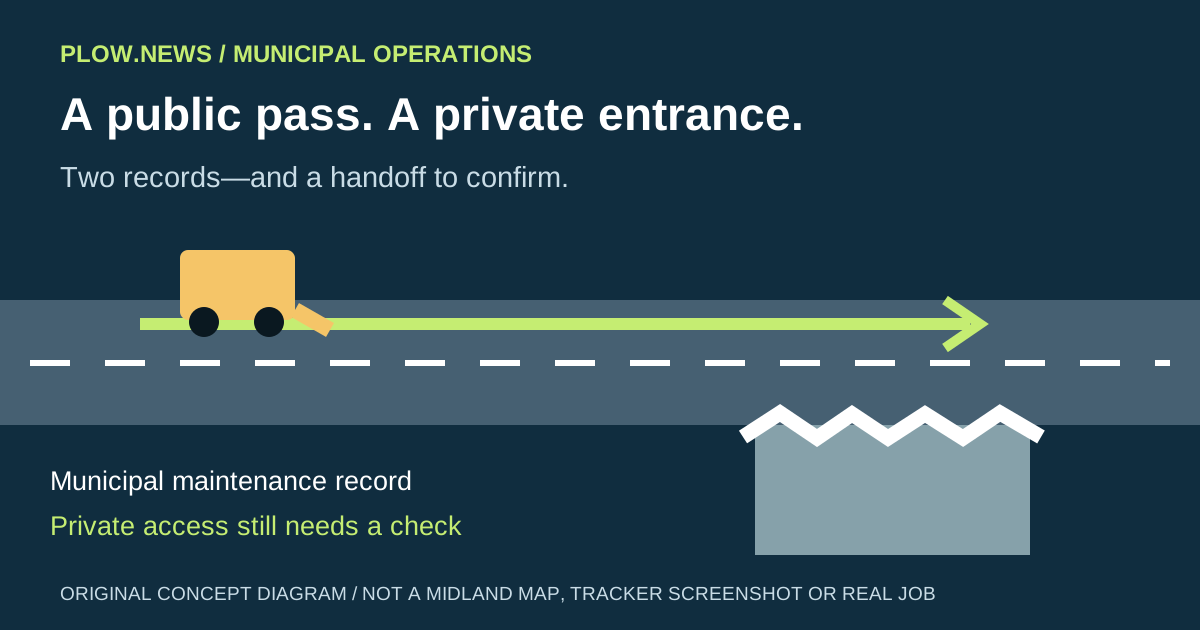
A municipal pass can reopen the private-work question
Midland’s winter-maintenance FAQ explains that road plows and sidewalk machines can leave windrows at driveway ends, and that the Town does not clear those windrows. For a private operator, the useful implication is a possible follow-up task after an earlier visit. Consider a clearly hypothetical property: the contractor clears its entrance, then a municipal pass leaves a new ridge across the approach. The first visit may have met its agreed scope, but the later condition needs a fresh decision. This is an example of a workflow risk, not a reported Midland customer job or a claim about any particular operator.

Agree on the follow-up before the ridge appears
The private service agreement should explain whether entrance rechecks or windrow removal are included, what evidence prompts a return and who can authorize additional work. It should also identify the contact available when normal office staff are absent. A municipal map may help explain the sequence of events, but it should not silently create a billable visit or an unlimited promise to return. Record the client’s actual instruction and the scope being accepted. Where the agreement is unclear, clarify it directly rather than presenting map activity as consent.
Keep the municipal crew’s working space clear
A tracker is an information tool, not permission to obstruct or approach equipment. Midland’s winter guidance says not to push snow onto roads, sidewalks or Town property. Its parking page describes annual November 15–April 1 restrictions, including midnight–7a.m. limits on Town streets and municipal lots, and says on-street parking is prohibited during a declared significant weather event. Check the current municipal rules and signs before staging a vehicle. A private operator’s convenient waiting spot cannot take precedence over public maintenance access. This is a source-linked summary, not legal advice about a specific parking situation.
Vancouver’s route map is a different kind of evidence
Vancouver publishes snow-removal priority routes for streets and bike lanes; the Open Data description says the extract is updated weekly. That is useful route context, but it does not establish a live vehicle location or a recent plow pass at an address. The City’s winter-maintenance page also sets out priority locations and identifies responsibilities beside non-City property. When comparing Midland and Vancouver, compare the questions their published information answers. Do not relabel a priority network as live tracking because both products appear on a map.

Local responsibility cannot be copied from another city
Vancouver tells owners and occupants to clear the full sidewalk width in front of and, for corner lots, alongside their property by 10 a.m. under its winter guidance. Midland’s FAQ describes a different municipal sidewalk-maintenance arrangement and says residents are not required to clear the sidewalk in front of their homes. Those examples show why an operating checklist needs a jurisdiction field. A contractor serving multiple places should link the appropriate municipality’s current guidance rather than reuse a generic deadline. Neither a tracker nor a private service proposal replaces the local requirements.
Make the handoff record useful without overcollecting
A practical record can keep three things together: the official source and time checked, the observed entrance condition, and the client’s decision about any follow-up. If a photograph is appropriate and permitted, frame the access issue rather than unrelated people, vehicle plates or private interiors. Do not turn a screenshot into a claim that a municipal employee has approved the private work. The purpose is a clear sequence that another authorized person can understand. Keep any exact address or customer information within the business’s appropriate private records.
What this does—and does not—mean for PlowWow™
Our analysis points to a useful coordination problem: public maintenance and private access work meet at the property boundary. It does not announce a PlowWow™ connection to Midland’s system, a municipal API agreement, automatic arrival alerts or a paid monitoring service. PlowWow™ Snow Intelligence remains beta; its actual status and any proposed capability should be confirmed separately. For a Lower Mainland property enquiry, use the real PlowWow™ contact route and confirm coverage, scope and availability directly. This Ontario report is not an offer of Midland snow-removal service.
The better question is whether the next person can act
Municipal transparency is most useful when a resident, property manager and contractor understand the same evidence. Before forwarding a map, ask: does it show a completed maintenance record, a planned route or a confirmed future estimate? Then ask what still needs checking on the property side and who owns that decision. Those questions turn a colourful display into a more careful conversation. They also prevent a past pass from becoming an unsupported arrival promise, a safety assurance or a claim that every part of a site has been cleared.
Town of Midland: March 6, 2026 tracker relaunch notice ↗
Midland: current winter road and sidewalk maintenance guidance ↗
Midland: Parking By-law2025-7 and winter restrictions ↗
Vancouver: winter maintenance and property-side responsibilities ↗
Vancouver Open Data: snow removal priority routes and weekly data currency ↗
Source reviewed Oct 29, 2026. The Midland relaunch occurred March 6, 2026; this October 29article reviews the current official guidance and adds original operational analysis. No municipal arrival time, private dispatch integration, alert subscription or contractor availability is claimed. The actual public tracker showed no currently shared operation during our October29 check; no live pass data was validated.
Related resources
Open Midland’s official public Plow Tracker →
Related: Surrey’s last-serviced tracker explained →
PlowWow™ property-service enquiry; confirm coverage and availability →